
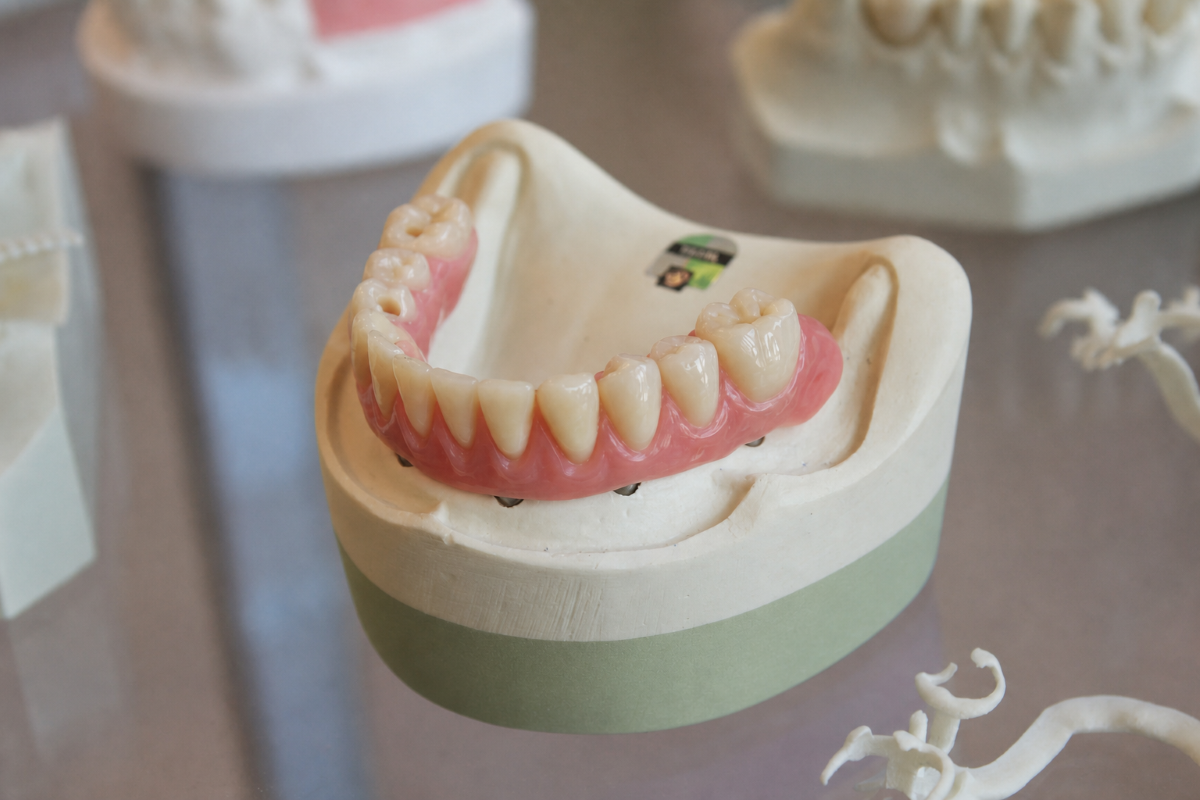
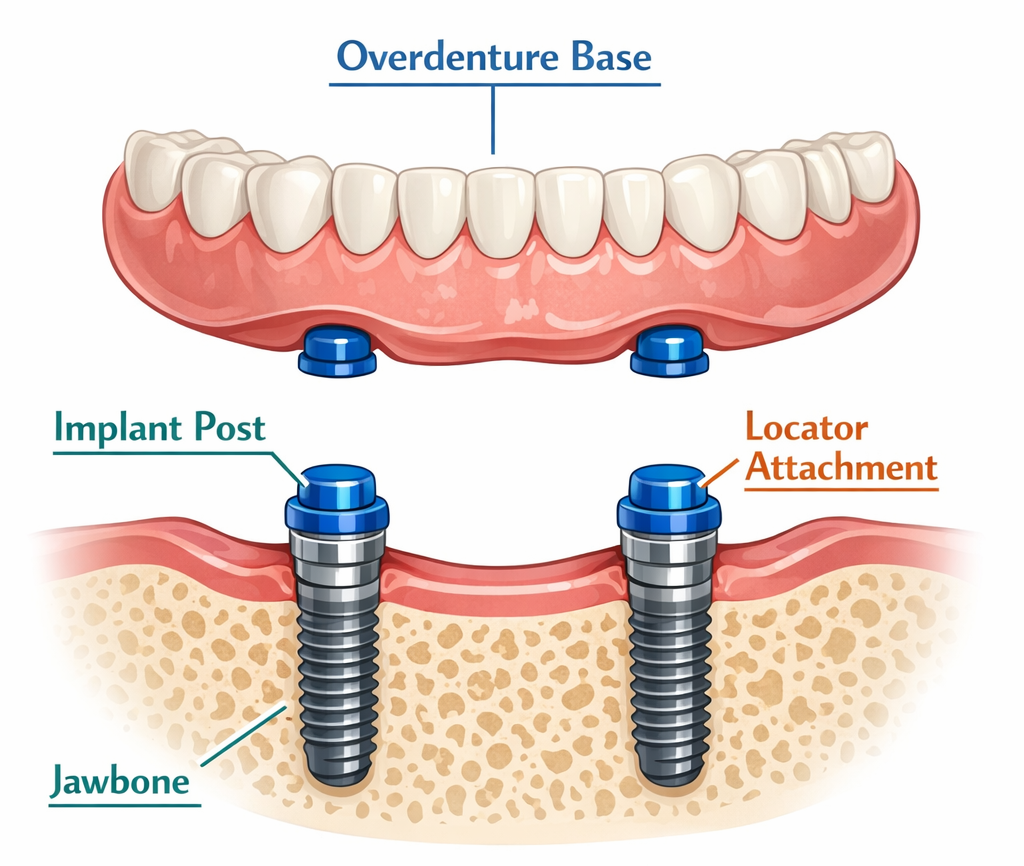
An overdenture is a removable prosthesis that fits over a small number of dental implants or prepared natural tooth roots, providing greater retention and stability than a conventional full denture. Because it anchors to implants or teeth rather than resting on the gum ridge alone, it helps slow the bone loss associated with complete tooth absence.
Why Patients in Guelph Choose Overdentures
- Improved stability: unlike a traditional denture, an overdenture snaps or clips securely onto implants or tooth roots, significantly reducing movement during eating and speaking.
- Bone preservation: implants transmit chewing forces to the jawbone, which can help slow the bone resorption that occurs when teeth are missing.
- Removable for easy cleaning: the overdenture unclips each day for thorough cleaning, keeping both the prosthesis and the underlying gum tissue healthy.
- Two supported types: implant-supported overdentures anchor to titanium posts; tooth-supported overdentures fit over shaped natural roots.
- A step up from dentures, a step short of fixed implants: overdentures sit between conventional dentures and a fully fixed implant bridge in terms of stability, invasiveness, and cost.
What Is an Overdenture?
A conventional full denture rests entirely on the gum ridge and, in the upper jaw, across the palate. Over time, as the jawbone resorbs, the fit loosens and the denture can shift during use. An implant overdenture solves this by securing the prosthesis to anchors embedded in the jaw, giving it a fixed point to clip onto.
The term snap-in dentures is commonly used by patients to describe the same appliance: a denture that clicks firmly into place on locator attachments or a bar connecting the implants. The clinical term is implant-supported overdenture, and both phrases refer to the same type of restoration.
At Guelph Village Dental, patients exploring overdentures in Guelph receive a thorough clinical assessment to determine whether their bone volume, gum health, and overall oral condition support this option.
Types of Overdentures
Implant-Supported Overdentures
This is the most common overdenture approach. Titanium implant posts are placed into the jawbone during a minor surgical procedure. After the bone has integrated around the implants, small attachment mechanisms are fitted to both the implants and the underside of the denture. The prosthesis then snaps firmly into place and can be removed by the patient each day for cleaning.
The number of implants used depends on which arch is being restored and the patient's available bone. The lower jaw typically requires fewer implants than the upper due to differences in bone density. Implant count will be assessed and confirmed at your consultation.
Tooth-Supported Overdentures
In some cases, a small number of natural tooth roots can be preserved and shaped to serve as anchors for an overdenture. This avoids the cost of implants while still providing more retention than a conventional denture. Whether tooth-supported overdentures are available at Guelph Village Dental will be determined at your examination.
Overdenture vs Traditional Denture: Key Differences
| Overdenture | Traditional Full Denture | |
|---|---|---|
| Support | Implants or natural tooth roots | Gum ridge and palate only |
| Stability | Snaps or clips securely; minimal movement | Relies on suction and adhesives; can shift |
| Bone preservation | Implants help slow bone resorption | Bone continues to resorb over time |
| Removable? | Yes, removed by patient for cleaning | Yes, removed by patient for cleaning |
| Palate coverage | Lower jaw: open palate design possible | Usually requires full palate coverage |
| Chewing comfort | Improved retention during eating | Can shift under chewing pressure |
| Best suited for | Patients wanting more stability than a denture but not committing to a fixed solution | Patients where implants are not indicated or budget is limited |
Are You a Candidate for Overdentures in Guelph?
Overdentures are generally suitable for patients who are missing all or most teeth on an arch and are looking for a more stable alternative to a conventional denture. Candidacy depends on several clinical factors:
- Sufficient jawbone volume to support implant placement, or existing tooth roots that can serve as abutments
- Healthy gum tissue free from active infection or significant untreated periodontal disease
- Commitment to the maintenance routine, including daily removal and cleaning of the prosthesis and regular dental check-ups
- General health status that supports a minor surgical procedure for implant placement
Patients who prefer the greater simplicity of a removable appliance over a fully fixed implant bridge, and who want more stability than a traditional denture provides, are often well suited to this option. Your dentist will assess your suitability at your first consultation and outline all available alternatives.
What to Expect During Overdenture Treatment
Treatment begins with a clinical examination, dental X-rays, and a review of your bone levels and existing oral health. If implants are recommended, the placement procedure is carried out under local anaesthesia. A healing period then follows while the bone integrates around the implants.
Once integration is confirmed, attachment components are fitted to the implants and to the fitting surface of the overdenture. The prosthesis is adjusted for fit, bite, and comfort before final delivery. Your care team will demonstrate how to remove, clean, and reinsert the overdenture, and will schedule follow-up appointments to monitor the fit over time.
For more information on implant-related care, the
[Canadian Dental Association (cda-adc.ca)] provides patient resources on implant treatment and prosthetic options.
FAQs About Overdentures
Book an Overdenture Consultation at Guelph Village Dental
- Clinical assessment of bone levels, gum health, and implant suitability to determine whether overdentures are the right fit for your situation
- A clear explanation of overdenture types, the steps involved, and how this option compares to other solutions including fixed implants and conventional dentures
Guelph Village Dental
7 Dovercliffe Rd, Unit B, Guelph, ON N1G 1B8
 Troy Newton
 Ashley Leanne
 F. Da Silva
 Carol and Jess Mott